How much space a guinea pig needs
A cage from a pet shop is almost always smaller than any standard — sometimes five times smaller. It is the most expensive mistake at the start, because it is the hardest one to undo later.
The numbers
The German veterinary association for animal welfare recommends at least two square metres of floor for two to four guinea pigs kept permanently. Each additional animal adds half a metre: 2.5 m² for five, 3 m² for six.
English-language sources quote smaller figures, and together they form a ladder rather than a contradiction. The bottom rung is 0.7 m² for a pair (7.5 sq ft, a 120 by 60 cm cage) — the absolute minimum named by the RSPCA and the Humane Society. The middle rung is about 1 m² (10.5 sq ft, roughly 76 by 127 cm), which the same sources call the preferred size and which is what a grid-panel enclosure gives in practice. The top rung is the German two metres: space in which a guinea pig behaves normally rather than merely fits.
The practical conclusion is simple: 0.7 m² is a line never to go below, 1 m² is where people realistically start, and 2 m² is what to work towards. Every figure on that ladder is for two pigs, not one.
A typical pet shop cage is 80 by 50 centimetres — 0.4 m². That is below even the most modest minimum and five times below the standard. Such cages are sold as «guinea pig cages», which is precisely why they sell.
Levels do not count
A second storey, a shelf or a roofed house adds no floor area. A guinea pig is not a hamster or a rat: she does not climb, does not jump upward and lives on the ground. In a two-level enclosure the lower level must provide the full area; the upper one is a bonus, not half the requirement.
If there is a ramp, it must be gentle and have sides. Steep ladders are either ignored or fallen off.
Why area, not volume
Guinea pigs move in bursts — they accelerate, hop on the spot and change direction sharply. That needs a straight run of at least two metres. A square metre-by-metre cage has the same area on paper and nowhere to build up speed.
Floor time is not a substitute
A common belief says the cage can be small if the animal is let out every day. It does not work that way. She spends twenty-two hours a day in the enclosure and is active at night, when everyone is asleep — which is exactly when she needs to move. Time outside is an addition, not compensation.
What works
- A pen built from wire grid panels — the cheapest way past shop-cage sizes: eight panels give about 143 by 73 cm, a little over a square metre.
- A child’s playpen or puppy pen with a washable floor.
- A fenced-off corner of a room — more common than you would think.
- A shelving unit with pulled-out shelves, if the bottom one gives the full area.
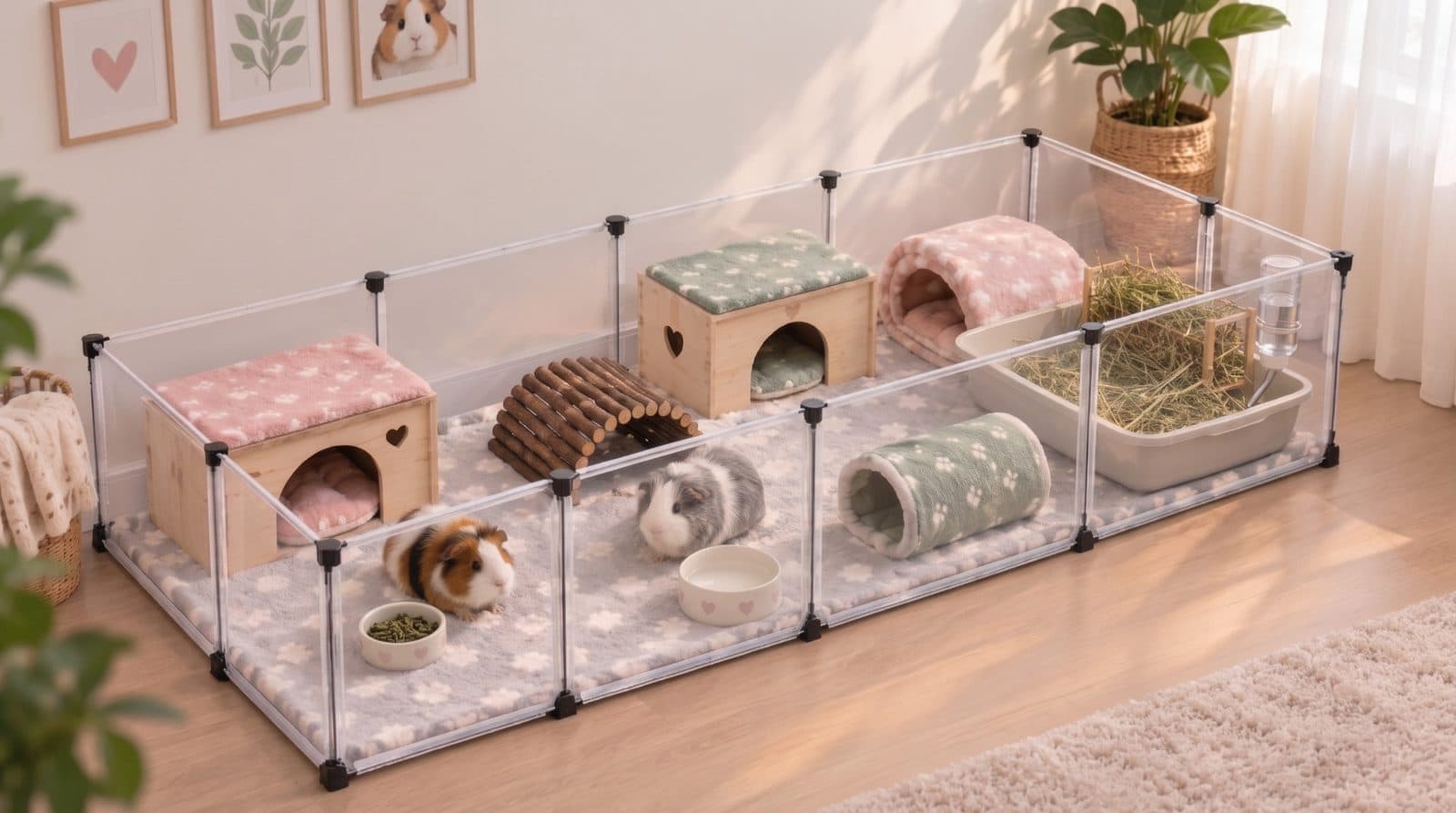
- Never: a wire mesh floor — it causes inflamed foot pads.
- Never: an aquarium or a solid-walled box — no ventilation.
- Doubtful: cages with narrow bars a head can get stuck between.
And the main thing
The standard is written for two, because a guinea pig does not live alone. If you buy one, you buy an animal that will spend its life missing the thing that matters most, and no amount of square metres fixes that.
In short
- Two guinea pigs — 2 m² of floor; +0.5 m² for each extra animal.
- The absolute minimum is 120 by 60 cm (0.7 m²); a sensible start is about 1 m².
- Levels do not add to the area.
- You need a straight run of at least two metres.
- Floor time does not rescue a small cage.
- Houses and a hay rack take up floor — count them on top of the standard, not inside it.